Castle Pals is a great retro platform game with 40 levels. Guide a character to jump over obstacles, avoid falling into lava, and fight against yellow goblins.
Hot on the heels of Rowdy Wrestling, the developer Brad Erkkila released Castle Pals. Rather than controlling only one hero from beginning to end, you have access to two characters with different strengths. One character is a powerful fighter who can deal heavy hits, while the other is a graceful flyer capable of reaching areas that would otherwise be difficult to access. Knowing when to use each character is a major part of progressing through the fortress. The castle is divided into individual rooms and levels, creating a straightforward structure that makes it easy to understand your immediate objective. You enter a room, deal with its obstacles, figure out how to use your characters effectively, and search for the exit.
The controls and objectives are easy to understand, but the castle is designed to test how well you can apply those mechanics.
Spikes are among the most familiar hazards in platform games, and they play an important role in Castle Pals. You need to judge your jumps carefully and avoid rushing into dangerous areas. A missed jump can quickly end an attempt, especially when multiple hazards are placed close together. Good timing becomes particularly important when you need to jump between platforms while avoiding other threats. The castle also contains movable saw blades. These hazards make some sections less predictable because their movement can interfere with your path. Instead of simply memorizing where a stationary trap is located, you need to pay attention to its movement and choose the safest moment to continue.
Platforming in this adventure game is not limited to jumping from one platform to another. You can also climb walls, adding another layer to the level design. Wall climbing can help you reach higher areas and navigate sections that would be inaccessible through ordinary movement. When combined with the flying character's abilities, vertical exploration becomes an important part of solving certain rooms. The level-based structure makes these challenges manageable because you can focus on the specific obstacles presented in each room. Instead of navigating one enormous open environment, you gradually work your way through a sequence of focused platforming challenges.
Yellow goblins are among the enemies you will encounter inside the castle. They add a combat element to the platforming and give the stronger fighter an opportunity to use their abilities. When an enemy blocks your route, you need to decide whether to engage it directly or find a safer way around the threat. The fighter's hard-hitting ability can be especially useful when combat is unavoidable. However, defeating enemies does not eliminate the need for careful movement. The castle remains full of environmental hazards, meaning a successful attack can still be followed by a poorly timed jump or a dangerous trap.
Fireballs create another threat that requires careful timing. You need to watch their movement and avoid entering their path at the wrong moment. Lava is an even more obvious danger. Falling into it can quickly end your progress through a section, so every jump should be approached with some awareness of what is below you. These hazards help create the game's sense of urgency. You are constantly evaluating the safest route through the room. The combination of enemies, spikes, saw blades, fireballs, and lava keeps the platforming focused and active.
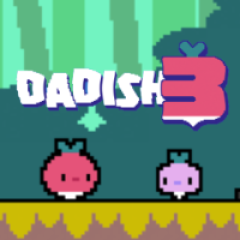
Like Dadish 3, this game also features many levels. You must complete 40 levels and each stage contributes another challenge to the journey through the fortress. The level-based format makes the game suitable for short sessions as well as longer play. You can focus on completing one room at a time, learn from mistakes, and then continue deeper into the castle.
Platform games naturally involve trial and error. In Castle Pals, a failed attempt can teach you something about the placement of traps, the movement of enemies, or the best character to use in a particular section. Instead of viewing a missed jump as the end of the experience, you can use it to adjust your timing on the next attempt. This is especially helpful in sections involving movable saw blades or fireballs. Once you understand how a hazard behaves, you can plan your movement more effectively.
Completing all 40 levels is one challenge, but Castle Pals gives you another reason to return to completed stages: gold. You can challenge yourself to finish each level within a certain amount of time. This turns familiar rooms into opportunities for optimization. After you know where the hazards are located, you can begin looking for faster routes and more efficient movement. The goal shifts from simply surviving to completing the stage quickly and accurately.
Improving your performance in a platform game usually comes down to timing, awareness, and understanding the mechanics. Castle Pals rewards the same habits.
When entering a new room, take a moment to understand what is ahead. Look for spikes, fireballs, saw blades, enemies, and gaps that could lead to lava. Knowing the basic layout can help you avoid unnecessary mistakes. You should also consider which character is best suited for the section. If an enemy is blocking the route, the fighter may be the better option. If the path involves difficult vertical movement, the flyer could provide a safer solution.
Speed is useful when you are chasing gold, but surviving the level comes first. Moving too quickly can cause you to miss a hazard or mistime a jump. Once you have successfully completed a stage, you can return to it and gradually improve your speed. This two-step approach works well: learn the level first, then optimize your route.
It can be tempting to rely on the character you find more comfortable, but the game is designed around their different abilities. The fighter's strength and the flyer's mobility serve different purposes. Switching between them gives you more options and can make difficult sections significantly easier. The more familiar you become with both characters, the more naturally you will recognize which one belongs in a particular situation.