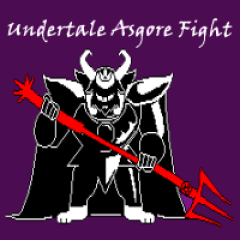
Undertale Asgore Fight is an interesting fan-made action game. Your objective is to evade various attacks from Asgore Dreemurr and defeat this boss.
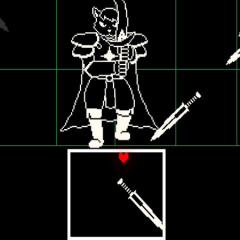
In this game, you must survive every assault, reduce Asgore's health to zero, and decide how the battle concludes. Although the gameplay is easy to understand, mastering every attack pattern requires excellent timing and concentration. The game recreates the tension of the original encounter while allowing players to practice the battle repeatedly. Since there are no lengthy cutscenes between attempts, players can focus entirely on improving their skills and learning every attack sequence. Asgore Dreemurr serves as the ruler of the Underground and stands as one of the most recognizable figures in the Undertale universe. His towering appearance immediately distinguishes him from other characters. Asgore is a large Boss Monster with white fur, long ears, curved horns, and a flowing golden mane accompanied by a thick beard. He wears regal armor decorated with golden pauldrons, a purple cape, and a small crown that symbolizes his position as king.
Like Undertale Toriel Battle, the heart of Undertale Asgore Fight also lies in its challenging bullet hell gameplay. Instead of directly attacking enemies throughout the fight, players spend most of their time avoiding incoming projectiles while searching for opportunities to survive until the next phase. Every attack pattern introduces unique movement challenges, forcing players to continuously adapt instead of relying on a single strategy.
The combat arena quickly fills with projectiles coming from multiple directions. Your objective is to guide your SOUL safely through increasingly complex patterns while minimizing damage. Even experienced players can struggle during later phases, as projectile density increases and reaction windows become much smaller. Remaining calm often proves more effective than making sudden, unpredictable movements.
One reason the boss fight remains engaging is the variety of attacks. Rather than repeating the same sequence endlessly, Asgore alternates between several projectile types that require different movement techniques. Some attacks encourage slow positioning, while others demand rapid dodging across the battlefield. Learning how each pattern behaves is essential for long-term success.
Knowing what to expect significantly improves your chances of surviving.
One of the earliest attacks sends four waves of small fireballs downward. Instead of moving in straight lines, these projectiles twist together in a double-helix formation. Although the pattern appears intimidating initially, careful observation reveals safe gaps that players can navigate through. Each collision deals moderate damage, making precision especially important.
Asgore frequently combines narrow projectile streams with enormous walls of fireballs that cover large portions of the battlefield. These attacks force players to anticipate movement instead of reacting at the last second. Finding the safest escape route before the projectiles fully develop is often the best strategy.
Circular groups of fireballs gradually spiral toward the center of the arena. As the battle continues, these spirals rotate faster and become increasingly difficult to avoid. Small, controlled movements generally produce better results than large directional changes.
During one of the encounter's more dangerous phases, Asgore's hands appear alongside the battlefield. They release large fireballs that lock onto the position where your SOUL was standing when the attack began. A useful tactic is to move immediately after the projectiles are released, allowing them to miss their intended target.
Large rings of fire descend from the top of the screen while gradually shifting across the arena. Although individual projectiles move slowly, the increasing density limits available escape paths. Maintaining awareness of the entire battlefield becomes more important than focusing on a single projectile.
Perhaps the most recognizable attack involves Asgore's glowing eyes. Blue and orange flashes signal sweeping trident strikes that cover the entire Bullet Board. Success depends on recognizing the warning colors and reacting quickly before the attack connects. These visual cues provide valuable preparation time for experienced players.
Movement
Actions
Managing health is just as important as mastering movement. Several useful healing items are available throughout the game.
The Cinnamon Bunny restores 22 HP, making it an excellent mid-battle recovery option. Players often use it after surviving multiple consecutive attack waves.
One of the strongest healing items, the Butterscotch Pie restores a significant amount of health. Saving it for later stages can dramatically increase your chances of finishing the encounter.
Restoring 45 HP, the Snowman Piece offers one of the largest health recoveries available. Because of its powerful effect, experienced players typically reserve it for emergencies.
Although it restores 14 HP, Starfait remains useful when only a small amount of healing is needed. Using smaller recovery items strategically can preserve stronger healing options for later phases.
After surviving every attack and reducing Asgore's health to zero, players reach the encounter's emotional conclusion. At this point, the game presents two choices.
Although both options conclude the battle differently, each reinforces the encounter's memorable narrative impact and gives players an opportunity to experience different outcomes.
Even highly skilled players rarely succeed during their first attempt. Fortunately, several strategies can improve your consistency.
Projectile arrangements often appear random at first. Instead of memorizing exact movements, focus on recognizing recurring attack behaviors. Understanding how each pattern develops makes adapting much easier.
Standing near the middle of the arena provides greater flexibility. From this position, you can move toward either side whenever projectiles close in. Being trapped in a corner usually limits available escape options.
Large, frantic movements frequently lead directly into incoming fireballs. Small adjustments are often sufficient for avoiding danger. Remaining composed allows you to notice safe openings that might otherwise go unnoticed.
Using your strongest recovery items too early can create problems later. Whenever possible, survive earlier attacks using careful movement and reserve high-value healing items for the encounter's most dangerous phases.
Since the game allows repeated attempts, every defeat becomes a learning opportunity. Over time, previously overwhelming attack patterns become much easier to predict. Consistent practice remains the fastest path toward victory.
Undertale Asgore Fight successfully captures the excitement of a high-intensity boss encounter while offering players an opportunity to sharpen their reflexes and strategic thinking. From intricate fireball formations and sweeping trident attacks to meaningful end-of-battle choices, every element contributes to an unforgettable challenge. With accessible controls, varied projectile patterns, useful healing items, and satisfying gameplay progression, this fan-made experience appeals to both Undertale veterans and newcomers who enjoy demanding action games, bullet hell challenges, and memorable boss battles. If you're ready to put your dodging skills to the test and face one of gaming's most legendary kings, Undertale Asgore Fight is an adventure well worth experiencing.