Moves are central to your performance in PokeSurvivor. Your Pokemon begins each run with one starting move, but you can unlock additional attacks through level-up choices and permanent progression. Every Pokemon can learn moves available to all Pokemon, as well as moves associated with its own types. This creates different possibilities depending on which Pokemon you choose.
Your Pokemon has three move slots available for regular use. When you level up, you can choose a new move if an empty slot remains and the move is part of your Pokemon's available pool.
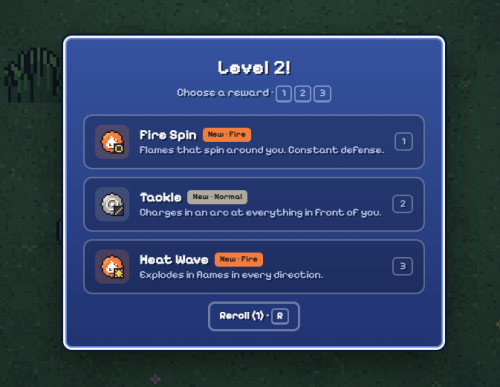
Figure 1: Selecting moves
The three-slot limit makes your decisions important. You cannot simply collect every attack offered during a run, so you need to consider which moves best support your preferred approach. For example, you may want to prioritize moves that deal serious damage, complement your Pokemon's typing, or provide useful effects against groups of enemies. The active-slot mechanic adds another layer to this system. Since only one move fires automatically at a time, switching between your learned moves becomes part of your combat strategy. There is also a special interaction involving buff moves. These moves do not deal direct damage, and once your Pokemon has acquired two buff moves, the game stops offering additional ones.
Move availability depends partly on your Pokemon's typing. All Pokemon have access to moves available to the entire roster, alongside moves associated with their own types. This creates a connection between character selection and combat development. Choosing a Pokemon is not only about collecting a familiar creature; its type can influence which attacks become available during a run. Single-type Pokemon also receive a 20% damage bonus when using moves that match their type. This makes type-focused builds particularly interesting. If you choose a single-type Pokemon, selecting attacks that match its type can help you benefit from this additional damage. However, the best approach still depends on the available cards, your current upgrades, and the enemies you encounter.
Move evolution is one of the most rewarding progression mechanics in PokeSurvivor. Instead of simply increasing an attack's level indefinitely, you can unlock a special evolution when specific requirements are satisfied. To qualify, a move must reach Lv 5, and you must have selected its required stat card at least once during the current run. Once both conditions are met, a golden evolution card is guaranteed to appear among your next level-up choices. This mechanic encourages you to plan ahead. If you want to evolve a particular move, you need to pay attention to both its level and the associated stat requirement. Reaching Lv 5 alone is not enough. Out of the 103 moves available in the game, 97 can evolve. Buff moves are excluded from this system. Because the required stat card differs depending on the move, it is useful to understand the evolution requirements before committing to a particular build. A well-planned combination of attack upgrades and stat selections can turn an ordinary move into a much more powerful option.
Besides, you can take a look at Bad Time Simulator, which is the most engaging game on our website.
Surviving ordinary enemy waves is only part of the challenge. PokeSurvivor gradually increases the difficulty as a run progresses, introducing scheduled boss encounters and occasional opportunities to fight legendary Pokemon in separate arenas.
These encounters provide additional pressure while also offering valuable rewards.
Boss battles appear at specific points during a regular run:
These scheduled encounters give your run a recognizable rhythm. You have time to collect experience and improve your Pokemon, but you also need to prepare for the next major threat.
Every boss drops one of the available held items, adding another reward to the combat progression.
Boss encounters are therefore important for more than simply testing your survival skills. They provide opportunities to obtain useful equipment while measuring how effectively your current build performs.
The bosses page in the game's reference information lists the Pokemon that can occupy each boss slot, making it a useful resource when learning more about the encounter system.
Rifts introduce a different kind of encounter. Sometimes, a rift opens near your position on the map. If you step inside, you enter a separate arena where you must fight a legendary Pokemon.
These encounters are distinct from ordinary waves because they temporarily move the action into their own battle environment.
Defeating a legendary Pokemon through a rift provides several tickets. There is also a 50% chance of receiving a ×10 ticket, making these encounters valuable opportunities for expanding your collection.
Another important reward is a bond. Bonds allow you to fuse several moves so that they fire together from a single move slot.
This mechanic has significant strategic value. Since your Pokemon normally has four move slots, combining attacks through bonds can free up space for additional moves. It provides a way to develop more complex combinations without being restricted by the original slot arrangement.
Rifts therefore connect combat achievement with build customization. Winning a difficult encounter can improve not only your collection resources but also the flexibility of your future move setup.
The regular run has a major late-game encounter known as Arceus's Judgment. This event begins at minute 30 and ends the standard run.
It provides a clear long-term survival objective. You can spend the earlier stages developing your Pokemon, collecting experience, fighting bosses, and exploring opportunities to enter rifts.
As the run approaches this final event, your decisions about damage, durability, cooldowns, and move evolution become increasingly important.
PokeSurvivor adds environmental variation through weather and changing biomes. These systems affect combat and can influence which strategies are effective during a run.
Weather begins rolling from minute 3. The game checks for a new weather event once per minute, with an 18% chance for each roll to trigger one. Once activated, weather lasts between 55 and 75 seconds, gradually fading in and out over approximately three seconds.
There are no weather rolls while you are inside a rift or after Arceus's Judgment begins.
Weather can increase the damage of attacks associated with certain types. Importantly, this effect applies to both your Pokemon and its enemies.
An enemy uses its first type when determining how it interacts with weather. These bonuses are applied in addition to the normal type chart.
This means weather can create opportunities for stronger attacks, but it can also make certain encounters more dangerous. You should pay attention to the current conditions rather than assuming every weather event benefits your build.
Sandstorms and snowfall also introduce a health-related effect. Unless your Pokemon has one of the types associated with the active weather, it loses 1.2% of its maximum HP every two seconds. This damage bypasses damage reduction, although it cannot directly knock your Pokemon out.
Enemies without one of the relevant types lose 2% of their maximum HP plus 1 on the same interval. Unlike the effect on your Pokemon, this environmental damage can defeat ordinary enemies. Bosses are unaffected by this health-loss effect.
Snowfall also slows enemies, which can create additional opportunities to reposition and avoid incoming threats.
Biomes change every few minutes, influencing which weather events are more likely to occur. However, weather that has already started continues even if the biome changes.
The map also contains several environmental features, including altars, springs, locked chests, and traps. These elements add more detail to the battlefield beyond the moving waves of wild Pokemon.
Understanding how weather, biomes, and map features interact can help you make better decisions during longer runs. Environmental effects are not simply visual additions; they can change damage output, enemy behavior, and survival conditions.
Combat progression is closely connected to Pokemon collection. New Pokemon are obtained through the gacha system, where each generation has its own regional banner. You use tickets collected during runs to perform pulls. This gives every battle a potential contribution to your collection, even when you do not obtain a new Pokemon immediately.
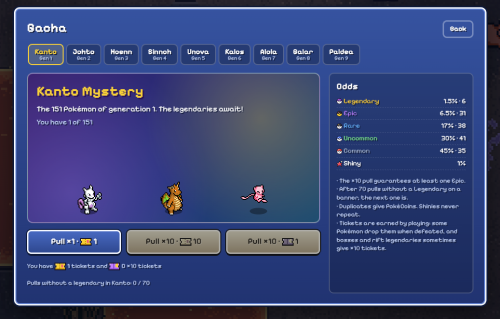
Figure 2: Upgrades-in-PokeSurvivor
There are several ways to collect tickets:
This variety encourages you to explore different parts of the gameplay rather than focusing exclusively on one type of encounter.
A regular run can help you collect tickets through wild enemies, while more demanding activities such as boss battles and rifts can provide additional opportunities.
The gacha system includes several important rules that help define your collection progress.
A 5-star Pokemon has a 1.5% chance of appearing with each individual pull. However, every regional banner guarantees a 5★ reward by pull 70.
A 10-pull multiplier also guarantees at least one Pokemon rated 4★ or higher.
Duplicate Pokemon are converted into coins, giving repeated pulls some value even when you obtain a character already in your collection. Shiny Pokemon are an exception because they never repeat.
For exact banner contents and complete drop rates, the game's gacha reference page provides the detailed information associated with each regional banner.
Shiny Pokemon add another collection objective to PokeSurvivor. These rare variants can appear through both ordinary encounters and gacha pulls.
Every wild Pokemon has a 1 in 4,096 chance of appearing shiny. If you defeat a shiny wild Pokemon, it is added to your collection.
The gacha system provides another route to shiny discoveries, with a 1 in 100 chance for an individual pull to produce a shiny Pokemon.
These two methods give you different opportunities to expand your collection. Wild encounters reward continued exploration and combat, while gacha pulls let you pursue Pokemon through regional banners.
The rarity of wild shiny encounters makes each discovery particularly notable. If collecting rare Pokemon is one of your main goals, keeping an eye on wild encounters can add another reason to remain engaged with each run.
Temporary level-up cards are only one part of character development. This endless game also features a permanent upgrade system that allows you to spend PokéCoins between runs. These upgrades are purchased separately for each Pokemon. Once you buy an upgrade for a specific Pokemon, it applies to every run you start with that character. Each additional level costs more than the previous one, so you need to consider how to distribute your coins.

Figure 3: Upgrades in PokeSurvivor
The available upgrades cover several aspects of combat and progression:
These improvements support different approaches to survival. For example, Vitality and Armor focus on durability, while Strength and Critical Hit improve offensive potential. Stride supports movement, and Reflexes reduces cooldowns. Wisdom helps you gain experience more quickly, while Magnet increases pickup range. Fortune improves your PokéCoin earnings, making it useful for long-term resource collection. Repertoire, Starting Move, and Second Starting Move are particularly relevant to build planning. They allow you to influence how your Pokemon begins a run rather than relying entirely on the initial setup.
PokéCoins are the currency used for permanent upgrades. You can earn them through several activities:
The Fortune upgrade and the Amulet Coin held item can increase the number of PokéCoins you earn.
Because upgrades become more expensive with each level, collecting coins consistently is important. You may want to focus on improvements that support your preferred Pokemon before spending resources across every available attribute.
Understanding the mechanics is the first step toward better runs. The next step is combining those systems in a way that supports your chosen Pokemon.