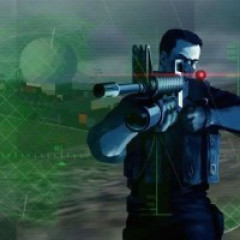
The story begins when an American W-88 nuclear warhead disappears from a storage depot in Germany. Concerned about the possible consequences, the Pentagon assigns former British SAS agent David Jones to investigate the incident. Jones travels to Tallinn, Estonia, where his first major objective is to locate and extract Josef Priboi, an Estonian arms dealer believed to possess important information about the stolen weapon. Rebecca Anya, his handler at the Pentagon, provides intelligence and operational support throughout the investigation. As Jones follows Priboi's trail, he discovers that the arms dealer has been kidnapped by his uncle, Jach. The situation becomes more complicated when Priboi reveals that Jach intends to sell the nuclear warhead to an unidentified buyer.
With the information uncovered, Jones and Anya begin tracking Jach's activities. Their investigation eventually leads them toward a mysterious woman known by the call sign Ekk, who appears to have connections to a rogue military organization or former KGB personnel. The operation becomes increasingly dangerous as Jones encounters armed forces, hostile aircraft, and a series of attempts to stop him from discovering the truth. What begins as a weapons recovery mission gradually turns into a race to prevent a nuclear catastrophe. David Llewellyn Jones is the central character of Project I.G.I. His background as a former British SAS operative makes him particularly suited to covert military operations, where discipline, tactical awareness, and combat experience are essential. As Jones, you are responsible for carrying out the objectives assigned by I.G.I. and the Pentagon. Your work involves entering heavily guarded locations, gathering sensitive intelligence, tracking important individuals, and confronting armed groups that stand in your way. Rebecca Anya acts as your primary source of mission information. Through radio communications and intelligence updates, she provides useful instructions, identifies new objectives, and helps connect the events of individual missions to the larger investigation. The relationship between Jones and Anya gives the campaign a clear operational structure. While Jones handles the dangerous fieldwork, Anya supports the mission from headquarters by analyzing information and monitoring developments.
The primary mission in Project I.G.I. is to investigate the theft of an American nuclear warhead, identify the people responsible for its disappearance, recover the weapon, and stop Ekk from using its components to create a nuclear threat. As David Jones, you must complete a series of military operations across different locations, including guarded bases, enemy compounds, transportation routes, and a former KGB training facility. Your assignments involve infiltrating restricted areas, eliminating hostile soldiers when necessary, recovering classified intelligence, locating important targets, and disrupting the activities of the organization behind the weapons trafficking operation. With Rebecca Anya providing intelligence support, you gradually uncover the connection between Josef Priboi, his uncle Jach, and the mysterious Ekk. The ultimate objective is to reach Ekk's base of operations, prevent her nuclear plan from succeeding, and stop a potential catastrophe before it is too late. Throughout the campaign, you must combine stealth, accurate shooting, reconnaissance, and careful planning to survive increasingly dangerous encounters.
Project I.G.I. contains 14 missions that unlock progressively as you complete your objectives. Each mission contributes to the larger storyline while introducing different locations, enemy positions, and operational challenges.
Rather than treating the campaign as one continuous firefight, the game divides the experience into individual assignments. You need to understand the purpose of each operation and prepare accordingly.
The main types of objectives include:
These objectives give the campaign a consistent military theme while requiring different approaches depending on the situation.
The storyline develops through several important operations.
Initially, Jones searches for Josef Priboi in Estonia and helps arrange his extraction with the assistance of Captain Harrison and his former Green Beret team. After Priboi is rescued, he reveals that his uncle Jach is attempting to sell the stolen nuclear weapon.
Jones then helps Anya investigate Jach's communications network. Their findings lead to another operation intended to capture him. However, the mission takes an unexpected turn when the extraction helicopter is attacked by Russian Sukhoi Su-27 fighter jets near the Russian border.
Jones survives the incident and escapes hostile forces before returning to Estonia. The investigation continues when Anya discovers that Jach is being transported by train. Jones intercepts the train, but Ekk's forces once again interfere, forcing him and Jach to escape.
The final stages of the campaign focus on Ekk's activities. Jones infiltrates her former KGB training camp, located inside a ruined mountain castle, but discovers that the nuclear warhead has already been dismantled.
Anya eventually realizes that Ekk has used its components to construct a suitcase nuclear weapon. Her investigation leads to an old plutonium refinement plant containing an operational nuclear reactor.
Jones infiltrates the facility and helps Anya gain access to its communications network. During the final confrontation, he faces Ekk and kills her, although Anya is wounded in the process. The campaign concludes with Jones and Anya awaiting extraction.
You are not simply moving from one group of enemies to another. Many objectives require you to understand the environment before deciding how to proceed. The game features large maps that provide room for exploration and different approaches to completing objectives. Enemy soldiers, security cameras, and alarms create obstacles that make careless movement dangerous. A successful operation often depends on how well you use the available information. Identifying guard positions, selecting suitable weapons, and choosing the right moment to move can help you avoid unnecessary confrontations.
Stealth is an important part of the Project I.G.I. experience. Military installations are protected by armed guards and security systems, so entering an area without attracting attention can be more effective than immediately opening fire. You need to observe patrol patterns and pay attention to your surroundings before approaching important locations. Security cameras and alarms can expose your presence, potentially creating additional problems during an already difficult mission. The ability to use binoculars is particularly useful when examining distant positions. Instead of approaching an unfamiliar building without preparation, you can inspect the area and identify possible threats from a safer distance. However, stealth does not mean that you must avoid every confrontation. Some situations require direct combat, especially when enemies discover your position or when an objective places you in an unavoidable firefight. The important distinction is knowing when to remain quiet and when to use force.
This action game features expansive environments that make exploration an important part of the gameplay. Military bases, compounds, and other restricted locations are designed around the objectives you need to complete. These areas provide a different experience from shooters built around narrow corridors and constant scripted encounters. You can spend time observing the surroundings, checking your map, and planning a route toward your next objective. The environment also affects how you approach combat. Enemy positions, available cover, and the distance between you and your targets can influence which weapon is most appropriate. This emphasis on spatial awareness gives the game a tactical identity that remains an important part of its appeal.
Like Grand Theft Auto V, this game also features a strong weapon selection. Project I.G.I. provides an assortment of firearms suited to different combat situations. You begin missions with certain equipment and can collect additional weapons from defeated guards. This allows you to adapt your loadout as the operation progresses. The arsenal includes close-range firearms, automatic weapons, precision rifles, shotguns, and heavier equipment for dealing with armored targets. Grenades also provide additional combat options. You can use fragmentation grenades against enemy positions, while flashbangs offer another tactical tool during encounters.
Although this shooting game offers several useful tactical systems, certain gameplay mechanics can make its missions more challenging. One particularly important detail concerns mission progression and saving.
Project I.G.I does not allow you to save your progress freely during an active mission. Your progress is saved only after you successfully complete the current assignment. This means that failing near the end of a difficult mission can force you to repeat a significant portion of the operation.
For this reason, preparation is especially important. Before entering a heavily guarded location, you should understand your objectives, inspect enemy positions, and consider how much ammunition and equipment you may need.
The save system also makes mission completion feel more consequential. You cannot depend on frequent checkpoints to protect you from every mistake.
If you are unfamiliar with the game, taking a slower and more observant approach can help you avoid unnecessary setbacks.
Project I.G.I also includes contextual interactions with objects and equipment. When you approach something that can be used, an interaction icon appears near the bottom of the screen. This indicates that you can perform an action such as operating a computer or accessing a specific object. Some activities, including hacking computers and climbing ladders, temporarily switch the camera from first-person to third-person view. Although this transition may feel unusual at first, it allows you to maintain awareness of the surrounding environment by moving the camera with your mouse. However, positioning is important. You need to line up accurately with an interactive object before you can use it. This can become challenging when enemies are nearby, and you have little time to react. Understanding these mechanics early can make navigating military facilities considerably easier.